
Milano–Sanremo: History and Route Through Liguria
Milano–Sanremo is a one-day race that runs from northern Italy through Liguria to the finish in Sanremo. For visitors, it is essential to check the route map for the relevant year: the start location, course, road closures, and spectator access may vary from one edition to another.
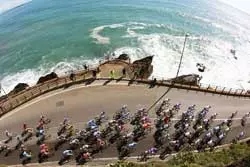 Mailand - San Remo
Photo: (under СС for commercial work) One-Fat-Man/flickr.com
Mailand - San Remo
Photo: (under СС for commercial work) One-Fat-Man/flickr.com
Milano–Sanremo: key facts
- The race is an annual road cycling classic that finishes in Sanremo.
- The 117th edition took place on 21 March 2026.
- In 2026, the route covered 298 kilometres from Pavia to Sanremo.
- In the Ligurian finale, the Cipressa and Poggio climbs come before the finish.
- For future editions, only the route and traffic arrangements published for that year apply.
A race with a long road to the coast
The 2026 edition started in Pavia and initially headed north towards Milan before joining the traditional route near Certosa. From there, the course went via Ovada and the Passo del Turchino to Genova-Voltri. It then headed west along the coast through Liguria. The final section went over the so-called Capi, followed by the Cipressa and Poggio, before reaching Via Roma in Sanremo. These details refer specifically to the 2026 edition and are not a prediction of a future route.
The official Milano–Sanremo 2026 route map includes the course and elevation profile for that year. It also shows why the name Milan–Sanremo does not mean that every edition starts in the same place or follows exactly the same route at every point. Changes to the northern section of the race can affect travel and spectator plans just as much as adjustments to the finale.
The Cipressa and Poggio before the finish
In the final stretch through Liguria, the Cipressa and Poggio are the two well-known climbs. The Cipressa comes before the final return to the coast; the Poggio follows closer to the finish. Both sections are part of the race’s historic drama, but their precise place in the route must be considered in light of the route for that year. The gradients, descents, and road width make the finale exciting for cycling fans, while the long distance explains why the riders reach the finish only after many hours.
Anyone hoping to watch the race in person should choose a single section. Visiting several locations along the route may not be practical on the same day: roads may be closed, spectator areas may be limited, and transport links may be disrupted. Choose a location, check the official traffic information for that edition, and plan your arrival and departure without tight connections. Use a precise passage time only if it comes from the official timetable for the year in question.
Experience Sanremo as the finish town
Staying in Sanremo is a good option for watching the finish. Find out in advance where spectators are allowed, which roads will be affected, and how to get to the station or your accommodation after the race. The Sanremo city guide can help you get to know the finish town beyond race day. If you plan to stay overnight, compare accommodation in San Remo by location and your own travel arrangements; for race weekend, confirm availability directly with the provider.
Sanremo is also known for its music festival. The cycling race and the festival are separate events, with their own dates, traffic measures, and visitor flows. If you are combining both in one trip, check the official information for each event separately and do not rely on historical dates. A walk around the city, a meal featuring Ligurian specialities, and a view of the sea can all be part of your stay regardless.
Choosing a good place to watch
The Cipressa, Poggio, and coastal roads offer different perspectives on the finale. However, a climb is not automatically the best spot for every visitor: steep approaches, limited space, and how you will leave after the riders pass should all factor into your choice. Families, older visitors, and people with reduced mobility should check how far it is from the station or car park to the spectator area and whether the organiser has published any guidance. Also plan for food and your return journey, as the usual way into a location may be temporarily unavailable during the race.
Check the route and travel arrangements well in advance
For a future race, wait until the organisers have published the new route map and local guidance before planning where to watch. Then check whether train, bus, or car travel suits your chosen location. In coastal towns, a short distance as the crow flies is not a reliable indication of actual travel time, especially when road closures are in place. This keeps your race plans realistic without carrying details from the 2026 edition over to another year.
