
Castelnuovo Magra: History and Wine in the Hills
Accommodation in Castelnuovo Magra, Liguria, Italy
Castelnuovo Magra sits on a hill in eastern Liguria, bringing together the history of the Bishops’ Palace of Luni and the wine-growing landscape of the Magra Valley.
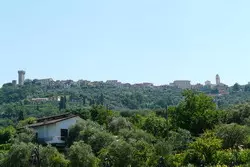 Castelnuovo Magra ist ein Städtchen mit historischen Ortskern und schöner Ungebung.
Quick facts
- The town grew around a fortification dating from the late 12th and early 13th centuries.
- On 6 October 1306, Dante Alighieri signed a peace treaty here on behalf of the Malaspina family.
- The Torre dei Vescovi di Luni is a striking remnant of the former palace complex.
- Castelnuovo is part of the eastern wine-growing area of the Colli di Luni DOC; tastings are not automatically available.
The hilltop town and its origins
Castelnuovo came into being in the late 12th or early 13th century, during a period of political conflict between the Bishop of Luni and the Malaspina family. Bishop Gualtiero had a castle built on a hill to secure an important route through the area. The first houses clustered near the fortification, and this settlement grew into the town we see today. Its elevated position still shapes a visit: streets climb uphill, and views of the Magra Valley and the plain open up between the houses.
The historic centre is easy to explore on foot. Take time to notice the routes between the squares and the buildings higher up, as they follow the contours of the land. A drive through the hills reveals a different landscape from a day on the Riviera. If you combine your visit with Sarzana or other places in Lunigiana, allow for the drive between destinations. Distances on a map give little indication of how long a winding route will actually take.
The Torre dei Vescovi di Luni and the story of Dante
The Torre dei Vescovi di Luni, also known as the Turris Magna, formed part of the bishops’ palace and defensive complex. The remains of the former complex include the large masonry tower, a smaller round tower and other traces. Standing near Piazza Matteotti, the tower gives the historic centre a clear focal point. As you explore, look beyond the tower itself to how the palace was positioned in relation to the streets and the hillside.
Castelnuovo is particularly well known for what happened on 6 October 1306: on that day, Dante Alighieri represented Marquis Franceschino Malaspina at the signing of a peace treaty with Bishop Antonio da Camilla. The event connects local history with a prominent figure in Italian literature. It is also a useful starting point for understanding the medieval power struggles between the Luni area and the Malaspina family. The municipal entry on the Palazzo dei Vescovi di Luni describes the complex and its location.
The tower ruins have been restored and are also used as an exhibition or event venue. This does not mean that opening hours are guaranteed. Check the municipal information before planning to visit the interior, especially if a particular date is the main reason for your trip. The exterior is worth seeing on a walk around town, even when access to the interior is not possible. Treat these as two separate options in your plans.
The Colli di Luni wine-growing landscape
The Colli di Luni wine-growing area extends into the Castelnuovo area. The DOC covers precisely defined areas in the province of La Spezia and neighbouring Massa-Carrara; its boundaries do not automatically include every part of the participating municipalities. Vermentino is closely associated with the designation, and the landscape of vineyard-covered slopes can be seen along the roads and paths. However, the protected designation of origin defines a place of origin and production rules; it does not guarantee that tastings are available to visitors. A winery may be closed or offer visits by appointment only.
If you are interested in wine, choose a specific winery and confirm its opening hours, tasting arrangements and directions directly before your visit. This way, you will not assume that the regional designation means tastings are available without booking. The drive through the hills can itself be part of the experience, linking villages and vineyards with wide-open views. Allow plenty of time and make sure you stop safely if you want to enjoy a viewpoint.
A visit to eastern Liguria
Castelnuovo Magra is a good fit for a cultural route through the Magra Valley, rather than a day spent entirely at the beach. In Sarzana, the focus is on further fortifications and a walk through the town; La Spezia offers museums and a harbour. Lerici adds the coastline of the Gulf of Poets to the route. These different highlights make it possible to plan a day that treats the hilly landscape as more than just somewhere to drive through.
On a short visit, focus on the town centre and palace complex. Wine visits or trips to several places require more time and confirmed opening hours. Places to stay in Castelnuovo Magra should suit your planned route and how you want to spend the evening; availability depends on your travel dates. If you enjoy history, architecture and local culture, Castelnuovo offers a peaceful contrast to the larger coastal towns.
Photo: Davide Papalini (Creative Commons licence)
