
Albenga: Roman city, medieval old town, and coast
Accommodation in Albenga, Liguria, Italy
Albenga is a good choice for a trip that brings together Roman and medieval history, regional cuisine, and time by the sea. At its center is a historic district whose layout is easy to read; beyond it lies the Piana, known for its vegetable crops, while the Via Iulia Augusta leads towards Alassio along a scenic coastal route. You don’t have to choose between visiting the town and spending time by the sea, but you should plan them as distinct experiences.
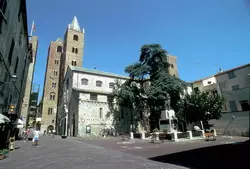 Albenga - schöne Altstadt hinter Stadtmauern.
Photo: Enit / Vito Arcomano
Albenga at a glance
- Albenga preserves traces of Roman Albingaunum and a historic center shaped by the Middle Ages.
- Piazza San Michele, the cathedral, the medieval family towers, and the early Christian Baptistery are all close to one another.
- The Via Iulia Augusta connects Albenga on foot with a historic route towards Alassio.
- The Piana di Albenga is known for its locally grown vegetables.
- From the old town to the beach and coastal route, town strolls alternate with walks outdoors.
From Albium Ingaunum to a Roman city
Before Roman rule, this was the settlement of Albium Ingaunum, home of the Ingauni; under the Romans, the city became Albingaunum. The Via Iulia Augusta connected it to the Roman road network. You can still trace part of the old street plan as you walk through the historic center: today’s Via Medaglie d’Oro follows the route of the Roman cardo. The contrast between the ancient street layout and the later medieval townscape makes Albenga especially interesting if you want to understand how a place evolved, rather than simply visit individual landmarks.
Piazza San Michele and the medieval towers
Start at Piazza San Michele. The cathedral and bell tower, the closely grouped family towers, and the lanes of the town center give the square its distinctive character. From there, continue your visit to Piazzetta dei Leoni and the Baptistery. The early Christian baptistery dates to the 5th century; its interior is octagonal, and a 6th-century mosaic is among its notable works of art. The entrance lies below today’s street level, making the historic change in elevation easy to see: here, you are close to the layer of the Roman city.
The towers are more than just a picturesque backdrop. In the Middle Ages, wealthy families had them built as a sign of their status. Together with the street network, the cathedral, and the Baptistery, they make for a walking tour that takes in Roman, early Christian, and medieval history at a handful of nearby sites.
The Piana di Albenga on your plate
Albenga is also an agricultural center. Four products particularly associated with the Piana are carciofo spinoso (spiny artichoke), purple asparagus, zucchina trombetta (trumpet zucchini), and oxheart tomatoes. They represent another side of this coastal town: vegetable growing shapes the plain as much as its beaches and historic buildings. If you enjoy eating local food, check the specific place of origin and seasonal availability when choosing what to try. For more ideas on typical Ligurian dishes and products, see the overview of Ligurian specialties.
Combining the old town, the sea, and the Via Iulia Augusta
The coast is an integral part of Albenga, and from the beaches you can see Isola Gallinara. One particularly appealing way to experience both town and sea is to follow the historic Via Iulia Augusta route to Alassio. Along the hillside route, you’ll come across Roman funerary monuments and stretches of the old road, while enjoying open views of the coast. The Municipality of Albenga estimates that the round trip to the last Roman monument takes at least two hours, and that continuing as far as Santa Croce takes three to four hours. The surface and terrain vary; the municipal route description for the Via Iulia Augusta provides the route and waypoints.
If you’d like to pair the outing with a longer stay by the sea, compare the character of Albenga’s old town with the beaches and lanes of Alassio. Albenga itself makes a good base if a historic town center and proximity to the Piana matter to you; you can choose from available accommodation in Albenga based on its location in town. For more destinations between the coast and the hinterland, consult the regional overview of the Province of Savona.
Albenga is especially well suited to travelers who want to add history, local produce, and a longer walk to a beach stay. For a day devoted purely to swimming and sunbathing, Alassio may be closer to the coastal experience you’re looking for; as a versatile base, Albenga offers several reasons to spend time in town beyond the beach.
