
Bonassola
Bonassola is a good choice for travelers looking to combine a compact seaside resort with a short cultural stroll and a longer coastal walk. The town center lies behind the crescent-shaped bay. Start at the beach, then walk through the pedestrian area around Piazza Cento Croci and Via Fratelli Rezzano. These squares form the heart of everyday life; the streets run parallel to the shore and lead on to the older lanes and the parish church of Santa Caterina d’Alessandria.
Church, square and western headland
Santa Caterina is the most important interior to visit for a brief cultural stop. Highlights include the colored marble, the Baroque carved woodwork and altar, and the devotion to the Virgin Mary reflected in the furnishings of the Rosary altar. Take time to look around at your leisure rather than treating the church simply as a landmark between the railway station and the beach. Piazza Cento Croci is then a good starting point for continuing to the western end of the bay.
The chapel of Madonnina della Punta stands on a small rocky promontory west of the gulf. The Poggi family had it built toward the end of the 17th century; the portico in front was added during a restoration in 1932. From the headland, the view follows the coast from Punta Mesco to the headland of Portofino. The exterior is visible; access to the interior depends on arrangements with the parish. Vehicle access is restricted and the approach has barriers, so it is best to plan to visit on foot from town. If you include higher neighborhoods such as San Giorgio, allow for the steep road and stairs as a separate leg of your walk. The parish church there dates from the second half of the 16th century; it stands above the town center and is not a step-free detour.
Beach and coastal path
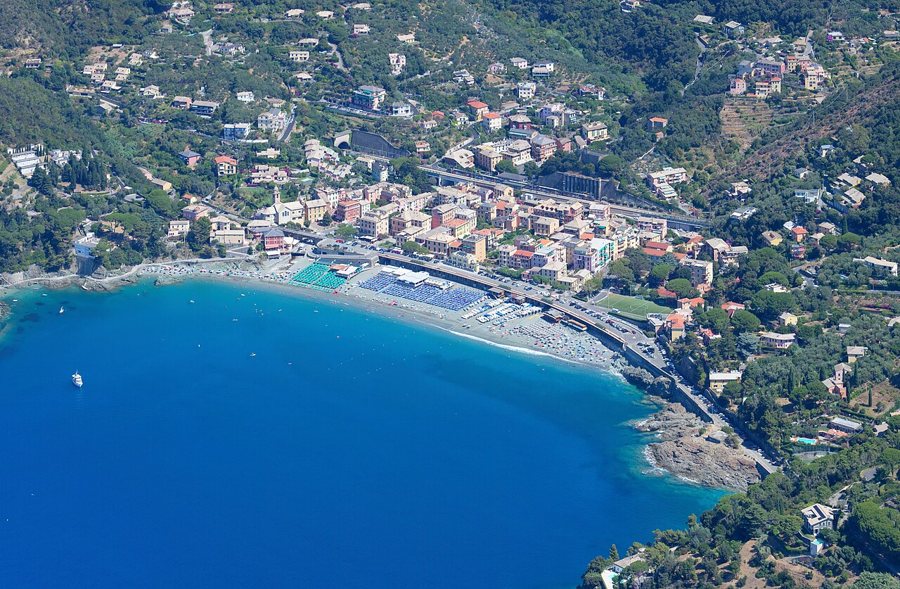
The main beach stretches between Punta del Carlino and Madonnina della Punta. The shore is mostly pebbles and small stones, with only a little sand; the seabed drops away relatively quickly. Bonassola is therefore better suited to swimmers who are happy with a stony beach than to those looking for a shallow sandy shore. Part of the old railway corridor along the coast can be used as a cycling and walking path. It connects the neighboring towns of Levanto and Framura through former railway tunnels. For the route, taking the train or walking it in stages is practical; if cycling or walking, plan for the tunnel sections and the distance you want to cover that day. A general overview of rail connections along the Ligurian coast can help you link the route with other towns.
Bonassola is accessible by car, but the historic town center and the area around the headland are not ideal for spontaneous drives right up to your destination: check access and parking against the Ligurian driving guide before choosing your accommodation. For a stay without frequent changes of location, choose somewhere near the station, town center and beach. See accommodation in the Province of La Spezia and the accommodation planning overview. The Province of La Spezia guide can help you weigh Bonassola against Levanto, the Cinque Terre and the Golfo dei Poeti.
Bonassola as a base
Choose Bonassola if being close to the beach and having quiet walks matter more than a wide range of sights or a busy evening scene. As a starting point for the coastal railway and the old railway path, the town combines time for swimming with short trips. If you want to visit several towns along the Riviera, you can use Bonassola as a base for train excursions; if swimming and walking are your main interests, combine the beach with a visit to Madonnina della Punta. The best order is simple: explore the town center and Santa Caterina in the morning, take a beach break, then walk to Madonnina if the light and your energy allow.
