
Levanto
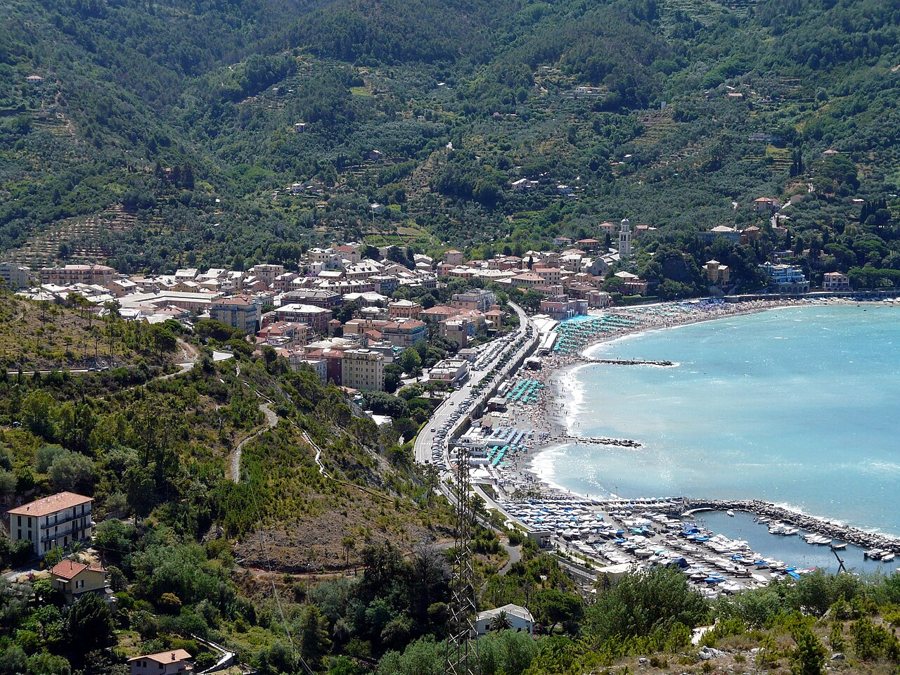
Levanto is an independent coastal town north of the Cinque Terre. It combines a long beach with a historic centre and makes a good base if you want to visit the surrounding villages without staying in one of the five towns themselves. From the railway station, walk towards Corso Roma and on to the old town. The main sights there are close enough together for a relaxed stroll.
From the church square to the Loggia and Castello
Start at the parish church of Sant’Andrea. Its black-and-white striped façade, built from local stone, is the most distinctive building in the town centre. Inside, look out for the late-medieval structure, the marble high altar and the 18th-century pulpit, as well as a painted wooden crucifix from the 15th century. Narrow lanes and steps lead from the church to the medieval Castello. The Scalinata San Giorgio connects the square by Sant’Andrea with the castle; from there, you can continue downhill to the seafront promenade. This route takes you through a clear sequence of religious architecture, a fortified vantage point and the coast.
On your way back, take a short detour to the late-medieval Loggia Comunale in Piazza del Popolo. It gives a sense of Levanto’s former importance as a regional trading centre. If you have more time, head behind Sant’Andrea to the former red marble quarry at Acquadolce. The quarry is directly behind the church and can be reached by stairs. On a first visit, don’t treat the town centre merely as a way to get to the beach: take time to explore the lanes linking the church, the Loggia and the castle.
Beach, Mesco and the Cinque Terre
After your walk, reach the broad stretch of coastline via the promenade. Levanto’s beach is longer than the small coves in neighbouring towns, and attracts surfers when the waves are stronger. For an outing in nature, the trail over Punta Mesco leads to Monterosso, passing the ruins of the hermitage of Sant’Antonio. This is a hike, not a short stroll by the sea, so plan it as a separate leg of your trip. The train is the convenient alternative for a day trip to the villages; the coastal railway and its connections can help with broad route planning.
Levanto is especially well suited as a base if you want restaurants, a beach and a railway station all in the same town, and plan to visit both Monterosso and the smaller coastal villages. To find a place to stay, compare accommodation in Levanto with the overview of choosing accommodation in Liguria. La Spezia Province situates Levanto alongside the Cinque Terre and the Gulf of Poets; for a comparison of the five villages, see the Cinque Terre comparison. If you’re arriving by car, plan parking and access to the town using the guide to driving in Liguria, rather than relying on your car for every trip between towns.
Which base is right for your trip?
Levanto is a practical base for a train trip covering several coastal towns: you won’t have to take your luggage with you every time you change locations, and you can alternate days at the beach with historic walks. If you’re mainly planning hikes on Mesco, choose your accommodation based on how close it is to the station and where you want to start. For a quiet beach holiday without frequent day trips, accommodation near the promenade may be a better choice. Levanto is therefore more than just a suburb of the Cinque Terre: it has its own town centre and long beach, and serves as a convenient base for exploring the area.
