
Tellaro
Tellaro is a small coastal village on the edge of the Golfo dei Poeti, whose charm lies in the interplay of its harbor, narrow lanes and steep slopes. Start at the waterfront and walk through the carrugi into the historic center. The paths are narrow and climb uphill, so sturdy shoes are a better choice than a stroller or heavy luggage. The Church of San Giorgio stands right by the sea and defines the village skyline. Its position recalls the coastal settlement’s defensive role, while local legend tells of the Polpo Campanaro, an octopus said to have warned of an attack by ringing the church bells.
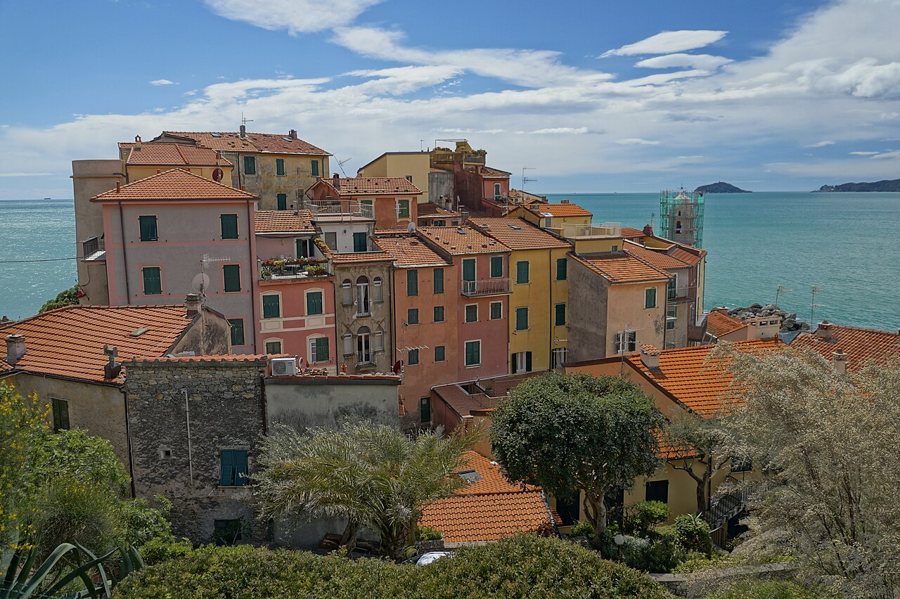
Three churches and the lanes
Combine San Giorgio with the Oratorio Santa Maria ’n Selàa and the newer Stella Maris church. The oratory was once the seat of the Brotherhood of the Penitents and was handed over to the brotherhood in 1630; today, the deconsecrated building is used by the community for events and exhibitions, among other things. Stella Maris preserves a medieval panel depicting the Madonna, Child and angels, originally installed in San Giorgio. The three places of worship tell different chapters of the village’s history and lie within a manageable walking tour, though the steps and narrow lanes make progress slower. Then wander without a set route through the lanes around Piazzetta Santa Croce and climb to a viewpoint overlooking the rooftops and bay.
Olive trails and abandoned villages
If you want to see more than the village center, climb from Tellaro along paths through olive groves to the ruins of Portesone and Barbazzano. The marked route through the regional park follows Sentieri REL 431 and 432 as far as Fiascherino: about an hour’s walking time, around 115 meters of elevation gain, and classified as an E-grade hiking trail. Along the way are the remains of abandoned Portesone, deserted in the 16th century after a plague epidemic, followed by the ruins of Barbazzano. A more demanding continuation leads via Zanego toward Montemarcello. These slopes are an addition to a visit to the village, not a level route connecting the coastal villages.
If you’re driving, don’t think of Tellaro as somewhere you can drive right up to the door: the village has a restricted traffic zone, accessible only to authorized vehicles. Choose an allowed parking spot outside the village and continue on foot, or combine your visit with the bus from Lerici; specific times depend on the date. For general guidance on planning your journey, see the Ligurian guide to roads and parking and the coastal connections. Tellaro or nearby Lerici make good bases: Tellaro is suited to quiet evenings by the sea, while Lerici offers a wider choice of services and excursions. Compare accommodation in the Province of La Spezia and the Ligurian accommodation planner.
Tellaro as a peaceful base
Choose Tellaro if you want to combine short walks around the village with coastal views and hikes on the Caprione promontory. It’s less convenient as a base for a car-free holiday by train with daily changes of location than somewhere near a railway station. The Province of La Spezia provides the wider geographical context. Half a day is enough for the church, oratory, lanes and a viewpoint above the village; allow an extra hiking leg for Portesone and Barbazzano.
