
The Abbey of Sant’Andrea di Borzone
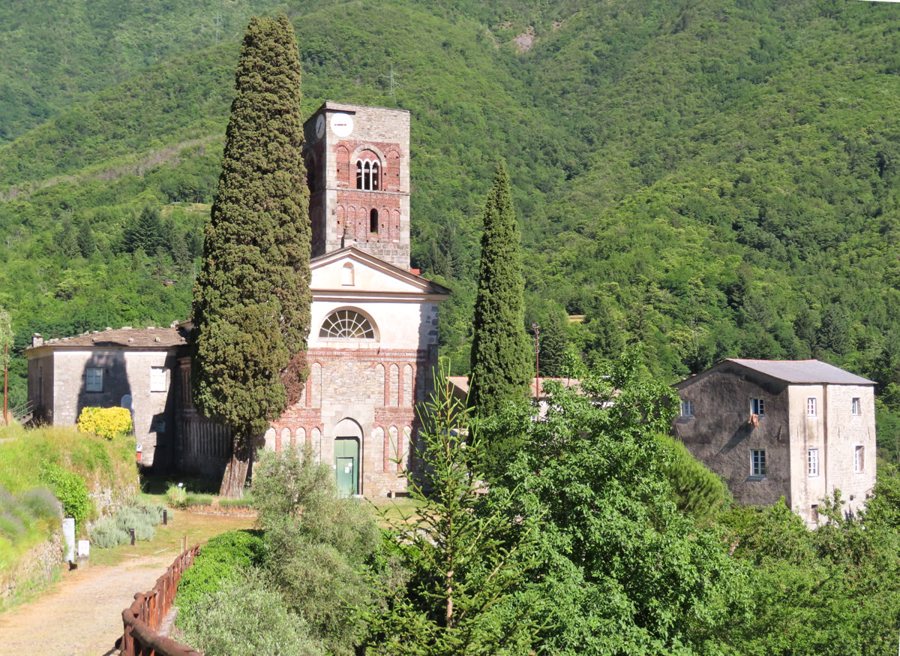
The Abbey of Sant’Andrea di Borzone lies amid the green hills of the Valle Sturla, inland from the Riviera di Levante. The church, campanile and remains of the monastic complex form an ensemble distinguished by its unusual combination of Romanesque and Gothic features and the contrast between grey natural stone and red brick. The site makes an appealing destination for an outing steeped in history and architecture, and offers a glimpse of the Genoese hinterland during a stay on the coast.
A monastery with a documented medieval history
A papal charter from 1120 mentions the monastery of Borzone. In 1184, it was entrusted to Benedictines from the Abbey of La Chaise-Dieu. An inscription on the campanile commemorates the church’s expansion in 1244 under Abbot Gherardo di Cogorno. These dates trace the development of an important religious centre in the Valle Sturla.
For centuries, the abbey was associated with a wider ecclesiastical territory. At the height of its influence, its remit included other churches, priories and a hospice. Its later transition from a Benedictine abbey to a commendam shaped the complex, as did building work in the modern era. Those wishing to combine their visit with other stops will find ideas in the Province of Genoa and the Ligurian Apennines. Chiavari is also a good base for exploring the surrounding area.
Stone, brick and a distinctive campanile
The building’s colour scheme is particularly striking: grey stone and red brick form a deliberate pattern of rows of arches, cornices and wall surfaces. The church faces west. Its side walls follow the contours of the land, so the different ground levels make their articulation less easy to discern in some places. As you walk around the complex, take time to view it from several angles and notice the interplay of the two building materials on the façade and side walls.
The campanile is the complex’s most recognisable landmark. Its lower section features bold rustication, with projecting blocks that give the tower a weighty, almost fortress-like appearance. Above are blind arches, followed by large triforia in the upper section. The spire has not survived. Inside the church, a reproduction recalls Carlo Braccesco’s 1484 Sant’Andrea Polyptych; the original is now in the Diocesan Museum in Chiavari. Those interested in sacred architecture can compare the abbey with other sanctuaries in Liguria.
Visiting the Valle Sturla
The abbey is in the hamlet of Borzone, near Borzonasca. Admission is free; according to the municipality, the car park and entrance are accessible to people with disabilities. Since 2007, the abbey has served as a house of prayer. For practical information about visiting, see the abbey website for contact details and visits.
The church, tower and surviving monastic areas bring the site’s long building history vividly to life. Restoration work on the complex as a whole took place from 2000 to 2012; the abbey was declared a national monument in 1910. The ensemble is particularly well suited to a peaceful architectural stop, with its carefully worked stone surfaces, brick arches and setting in the hills shaping the experience. For a place to stay nearby, see the accommodation search for Borzonasca.
