
Villa Faraldi: Caselle and stone walking trails
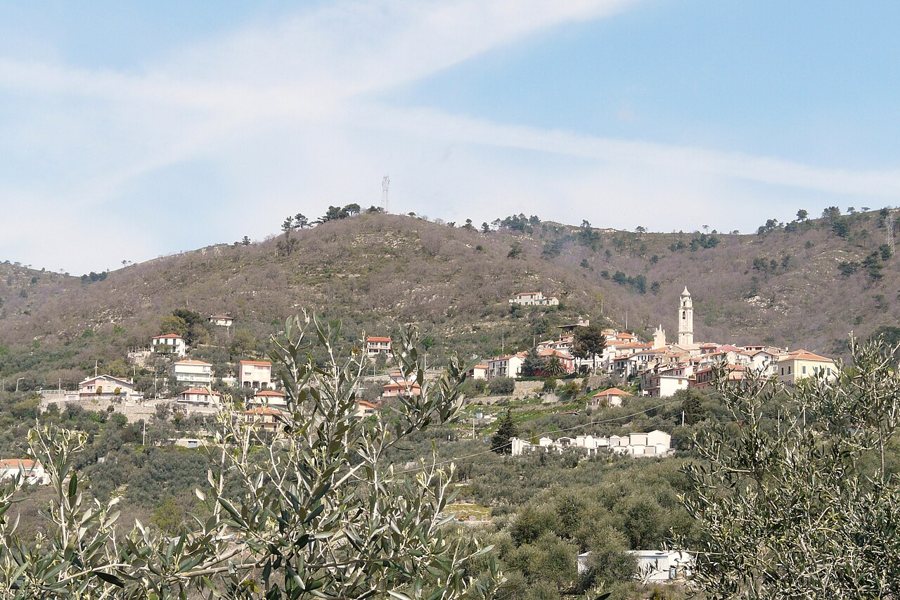 Villa Faraldi im ligurischen Hinterland. Foto: Davide Papalini, CC BY-SA 3.0.
Photo: Davide Papalini
Villa Faraldi and Caselle at a glance
- The Sentieri di Pietra follow old mule tracks in the Valle Steria.
- Caselle are small field structures used to store tools and provide temporary shelter for people or animals.
- Tra Santi e Oratori starts in Tovetto: 3.2 kilometres, 217 metres of elevation gain and about 1 hour 15 minutes.
- The Anello dei Laghetti starts in Deglio Faraldi: 3 kilometres, 180 metres of elevation gain and about 1 hour 15 minutes.
- The trails connect the landscape with churches, oratories, waterways and traces of agriculture.
The stone paths of the Valle Steria
Villa Faraldi lies in the Valle Steria, a valley whose slopes have been shaped over generations by dry-stone walls and agricultural terraces. The municipality refers to the walls in the local dialect as “maxé”: they are made of dressed stones laid without mortar and wedged together with small stone chips. The same building technique can also be found along old rural paths. Votive images, former oil mills, medieval bridges and the ruins of small churches line the mule tracks.
Caselle are a distinctive feature of rural architecture. These small stone field structures were used to store tools and occasionally as temporary shelter for people or animals. Along the paths, they are closely associated with farming and pastoralism. The landscape can thus be read as a working environment: walls held the soil on the slopes, paths connected the villages, and caselle provided shelter and storage close to the fields.
Tra Santi e Oratori: a cultural walk from Tovetto
The walk begins in Tovetto at the 16th-century church of San Sebastiano and first leads to the small wayside shrine of Santo do Causetta. It then descends to the Tovo stream, whose water once powered the gumbi, or mills and oil mills. Caselle also lie along the route. The subsequent climb reaches the oratories of Madonna della Lea sottana and Lea soprana. The lower chapel dates from the 17th century and was used as a storehouse in the 20th century; the upper one was converted into an art studio during the same century.
At the end, the path leads into the village centre of Villa Faraldi. The church of San Lorenzo is an important landmark in the Valle Steria and contains works of art and frescoes. From 1580 to 1980, the Oratorio di Santa Caterina was home to an active confraternity; it later became the studio of Norwegian artist Fritz Røed. The site continues to be used as an art studio. At 3.2 kilometres, with 217 metres of elevation gain and a stated duration of 1 hour 15 minutes, this walk links religious buildings and rural culture on a compact route.
Anello dei Laghetti: water and mill history
Those who would rather follow streams and mills than visit the oratories can start in Deglio Faraldi. The three-kilometre Anello dei Laghetti has 180 metres of elevation gain; the published walking time is also 1 hour 15 minutes. At the start is the church of San Bernardo, an 18th-century building erected on the foundations of a medieval parish church. Its history is connected with the distribution of water, which was essential for farming and milling.
The path descends to the Torrente Cervo and the Laghetto del Mulino, where watermills once stood; some were later converted into oil mills. The route continues via the tributary Rio Ausebecco and the Pian Doddo area to the Torrente Steria and the Laghetto del Serpente. The loop then climbs along a mule track to the provincial road and returns to Deglio Faraldi. This makes the walk quite different from Tra Santi e Oratori: the focus is on water, the history of milling and two small lakes, rather than the chain of oratories between Tovetto and Villa Faraldi.
Where to stay and what other places can you visit?
If you would like to combine the walk with a beach stay, look for accommodation on the coast in Diano Marina or Cervo. Diano Marina and Cervo are coastal towns; Villa Faraldi is a separate detour into the Valle Steria. When driving into the hinterland, allow for the winding roads involved in driving in Liguria. If you are planning several days of sport, you can combine walks with other forms of active holidays in Liguria.
FAQs about the Sentieri di Pietra
Where does the Tra Santi e Oratori loop start?
It starts in Tovetto at the church of San Sebastiano and follows the Torrente Tovo, passing caselle and the oratories of Madonna della Lea before reaching the village centre of Villa Faraldi.
What is a casella?
A casella is a small stone field structure used to store tools and, at times, to shelter people or animals.
