
Arcola: Torre Obertenga, the Castle and Trebiano
Accommodation in Arcola, Liguria, Italy
Arcola is a hilltop town in the lower Val di Magra, with sights spread across its historic centre and smaller settlements. Torre Obertenga and Trebiano reveal two different sides of the medieval history between the valley and the coast.
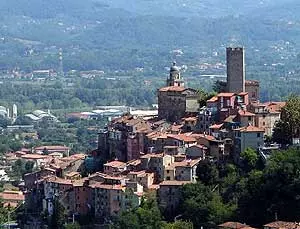 Arcola - das ist der Charme des ligurischen Hinterlandes.
Photo: Davide Papalini / Wikipedia.de, CC BY-SA 3.0
Arcola at a glance
- Torre Obertenga stands in Piazza Ugo Muccini in the old centre.
- The pentagonal tower is about 25 metres high and dates from around the 10th century.
- Today, the tower houses MaP – Museo Arti e Paesaggi.
- Trebiano is a separate hilltop castle settlement within the municipality.
- The interior of Trebiano Castle is not open to visitors.
Torre Obertenga and the Palazzo
The pentagonal Torre Obertenga is a striking landmark in Piazza Ugo Muccini. The municipality dates its origins to around the 10th century and describes it as approximately 25 metres tall. Its shape was part of the borough’s former defensive system; the narrow openings and its position by the entrance make this function easy to understand. Today, the tower houses MaP – Museo Arti e Paesaggi. Before visiting the interior, check the museum’s current information at the museum, since opening hours and access cannot be inferred from its historic use.
The Palazzo Obertengo stands right in the old town centre and, following restoration work, is now used as the town hall. Its history runs from the sphere of power of the Obertenghi through the Malaspina and Genoa to later conflicts. A walk from Piazza Muccini takes in the tower, the palazzo and the lanes of the elevated town. The buildings are interesting not only individually; together, they explain how Arcola’s strategic position shaped the development of its fortifications.
The municipal description also highlights the structure’s design: its pentagonal shape, narrow openings and position opposite former entrances reveal its military purpose. Damage sustained during the fighting of 1799 led to restoration work in the early 20th century. The work stabilised the masonry and wooden structures; the municipality attributes the site’s designation as a national monument to this history of preservation. For visitors, it is important to consider the exterior, museum displays and access to the interior separately: a museum in the tower does not mean that every area is open at all times.
Trebiano and the hill settlements
Trebiano is a separate castle settlement, not simply another name for the centre of Arcola. The municipal tourism service cites 963 as the first recorded mention of the castle and describes its views across the Magra Valley to the sea. This date is considered an early reference, not a confirmed date of construction. The complex rises above the settlement, but according to the municipality, its interior is not open to visitors. A visit is therefore chiefly worthwhile for its setting, exterior architecture and views.
The municipality also includes places such as Baccano, Cerri, Monti, Fresonara, Romito and Termo. They are not all directly adjacent to one another. If you plan to visit several, plan each journey separately and expect uphill stretches rather than one continuous, level walk. If you have limited time, you can focus on Arcola and Trebiano and explore the rest of the Val di Magra another day.
By bus from La Spezia
ATC route 22 connects La Spezia and Arcola. The operator publishes seasonal timetables with separate information for each day of the week; before travelling, choose the appropriate stop and check the current service. The ATC timetable booklet is the official source for winter services. Departure times may change, so make sure the timetable matches your planned travel date.
Arcola as a cultural side trip
Arcola is a good choice for a visit focused on medieval architecture and the landscape of the Magra area. If you want to combine the coast with a castle, Lerici offers a different kind of destination; for museums and rail connections, La Spezia makes a convenient urban base. Sarzana focuses on its old town and fortifications, while Vezzano Ligure also brings together historic hillside settlements.
A few hours are enough for a focused visit taking in the tower, the palazzo and the lanes of the town centre. Trebiano adds a second settlement to the trip, but requires separate travel and extra time. If you are staying in the area, compare options for a town base with rail connections in the La Spezia accommodation overview. This makes it easy to plan Arcola as a cultural destination without mistaking it for a seaside resort or a large city.
