
Pignone: village centre, Loggia and Ponte Vecchio
Pignone combines a compact village walk with historic bridges and an unusual karst landscape. On Piazza Guglielmo Marconi stands the Loggia, a 17th-century reconstruction created as a ceremonial arch on a road built by the Republic of Genoa. The Ponte Vecchio is a different structure: a stone single-arch bridge whose basic structure dates back to the year 1000. It was destroyed in the flood of 25 October 2011 and subsequently rebuilt. Outside the Borgo, the 16th-century aqueduct bridge with six arches adds another stop to the visit.
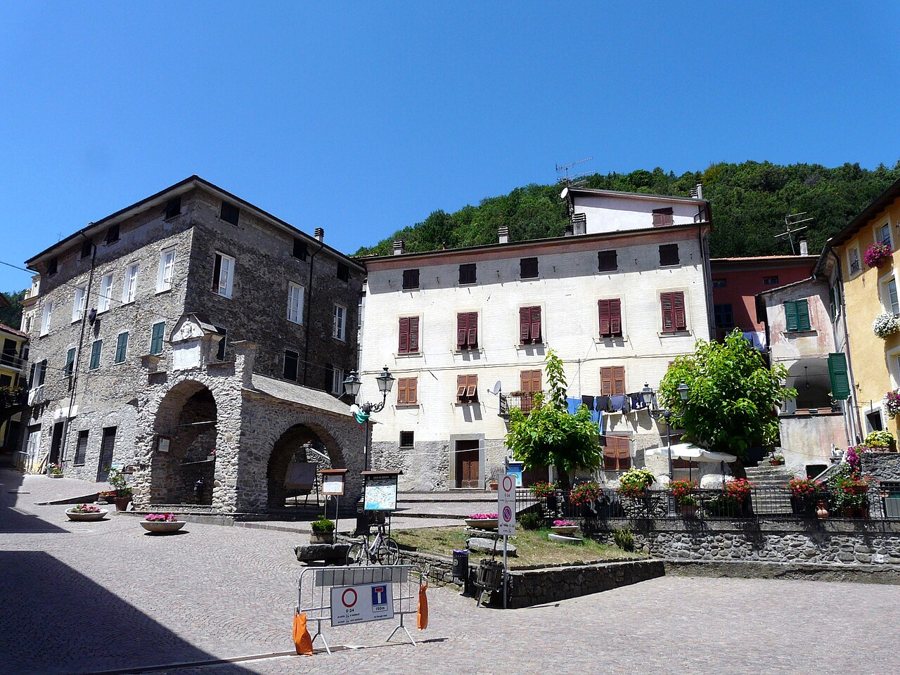
In the village and at the old aqueduct
Start at the Loggia on Piazza Marconi and walk from there to the Ponte Vecchio, which once served as the only entrance to the Borgo. The local route continues via Aretta to Via Superiore, through the narrow lanes of Via Piaggio and up to the forecourt of the Pieve of Santa Maria Assunta. To see the aqueduct, leave the village centre: the six-arched stone bridge lies about a kilometre away, surrounded by trees. Its construction shows how water channels crossed the hilly terrain.
The Sant’Antonino karst area
A second, separate detour is along the road from Pignone to Casale. The municipality describes a cave system about twenty metres deep and a swallow hole, with information panels at its entrance explaining the karst and its wildlife. Bats and the Ambrosi cave salamander are among the species mentioned. A botanical trail introduces mosses, ferns, lichens and other plants; it was created with the local school and dedicated to Erminio Ferrarini. The first section of CAI Trail 06 is dedicated to Augusto Cesare Ambrosi, a scholar of Ligurian history. The botanical trail was established in 2005 by Olimpia Cecchi with the help of local primary school pupils, linking nature observation with the history of local education. At the entrance, the information panels take centre stage, connecting the area’s geological formations with its animal and plant life.
For directions, the municipality gives a clear route: from the Brugnato motorway exit, take the Aurelia state road towards La Spezia as far as Pian di Barca, then turn towards Pignone and Levanto. The cave is on the road towards Levanto, just beyond the turn-off for Pignone. If you are visiting only the village centre, combine the Ponte Vecchio and the aqueduct; for Sant’Antonino, plan a separate stop by car. The provincial profile places the town between the coast and the inland area; Varese Ligure provides a comparison with the valley. For an extension along the coast, explore destinations in Levanto and the Cinque Terre overview. Use the driving guide to include the valley in a longer trip, and choose a suitable base with the accommodation overview.

